
Walk a South Salt Lake Street From Address to Record
A useful street directory trail moves from the concrete address to records that use different keys. Start with the Salt Lake County Assessor, where the owner, address, or parcel number can produce a current property lead. Use the parcel viewer to see the lot shape and neighboring parcels. Then compare the address with the Utah voter-status form, search the Recorder for a deed or legal description, and use older geographic directories when the question reaches into the past.
The order matters. The Assessor is about property data, not live occupancy. The voter lookup is about registration status, not every household member. The Recorder is about recorded instruments, not a current list of people. A directory by street works best when each result is labeled with its custodian, date, and purpose.
- Enter the house number and street parts in the Salt Lake County Assessor search.
- Open the Salt Lake County GIS or Parcel Lookup view and inspect the adjoining lots.
- Run a voter-status check with the name and address you can support.
- Use the Recorder’s public search or Data Services to follow parcel-linked documents.
- Ask the library for a geographic or criss-cross volume when you need past occupants.
South Salt Lake Street Directory: Assessor Fields
The Salt Lake County legacy Assessor search is unusually helpful for a street directory because it separates parts of the address. It shows controls for owner prefix, frontage number, direction, street name and number, street type or direction, and parcel-prefix search. The current Find a Parcel route also supports owner, address, and parcel-number searches. Try more than one form if a name or street entry does not match on the first pass.
| Search field | Use on a South Salt Lake street | What to record |
|---|---|---|
| Owner prefix | Limit a name search before the street search | Exact spelling and result date |
| Frontage number | Separate one house number from a long block | Number, unit note, and parcel ID |
| Direction | Distinguish a directional street label | N, S, E, or W as shown |
| Street name and type | Match the situs address | Name, Avenue, Street, Road, or other type |
| Parcel prefix | Review a related parcel group | Prefix and map relationship |
Do not treat an owner match as a resident match. The tax mailing address and the physical situs address are separate, and the owner may be an estate, trust, business, or person who lives elsewhere. The parcel number is more reliable than a loose name when you move to the Recorder or GIS.
South Salt Lake Street Directory GIS Parcel Walk
The county GIS route and its Parcel Lookup screen add a visual check to the street directory. The inspected lookup exposes house number, directional, street name, street type, ZIP, parcel number, and a “Looking for” selector. Search the address, open the parcel result, and use the surrounding geometry to identify the lots that share the block. The map is useful for seeing that one street number may sit near several parcel shapes, or that a corner parcel may have more than one frontage.
Save the parcel number and legal description shown with the property result. A map layer can help you find adjacent parcels, but the county’s map is not a substitute for the recorded instrument. If the geometry, street label, and mailing address do not line up, stop and ask the Assessor or Recorder which key controls the next search.
Open the Salt Lake County Assessor GIS page before comparing this captured screen.
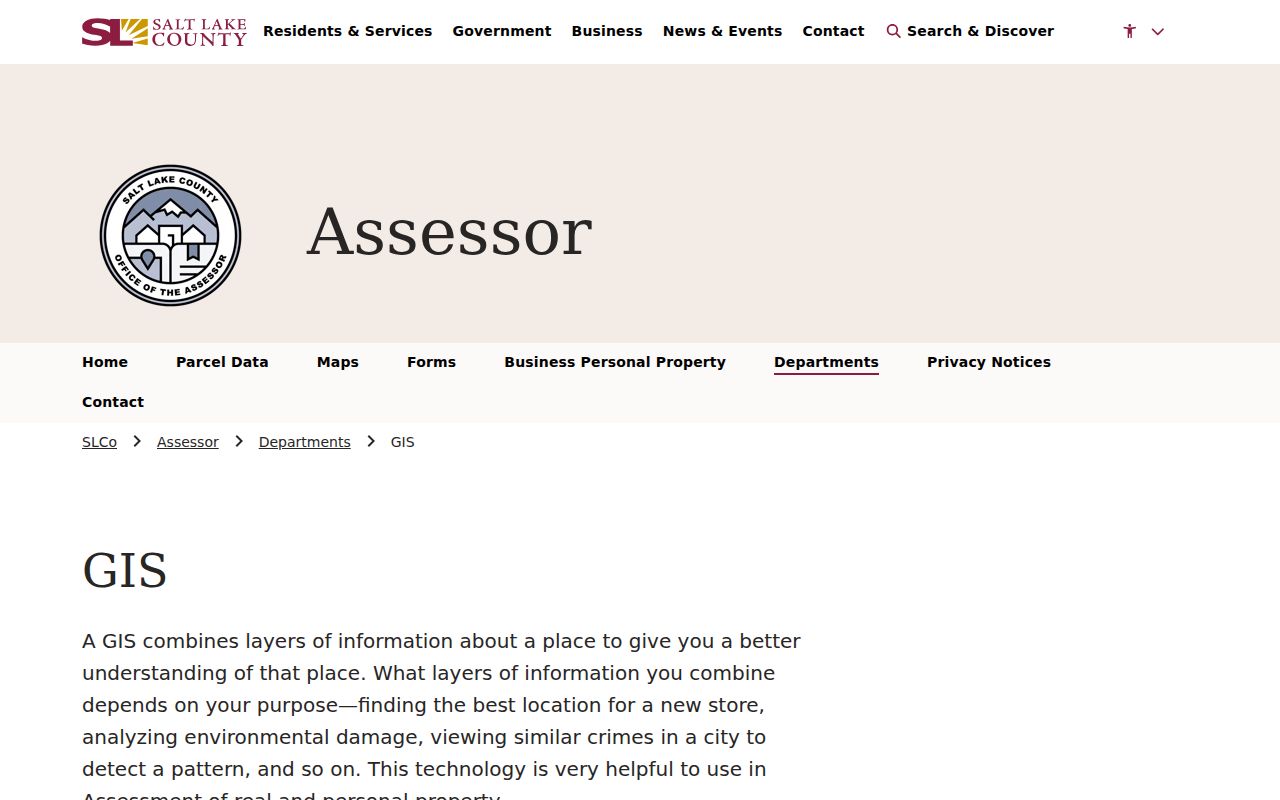
The county Parcel Lookup screen shows why a street-by-street search needs more than a name. Its field choices help separate a situs address from a mailing label and then point the search toward the parcel record.
Street record terms. A parcel is a mapped unit of land. A situs address is the physical location. A plat is a recorded map of lots and lines. A criss-cross directory reverses the usual name order and organizes entries by street or address.
South Salt Lake Street Directory Legal Descriptions
Street names change in everyday use, but a legal description is meant to identify the land through a subdivision, lot, block, tract, or other recorded description. That makes it the bridge between a current Assessor result and an older deed. The Recorder’s Data Services describes searches for owner of record, parcel-number history, legal descriptions, recorded documents, tract index, chain of title, subdivision maps, and plats.
The free Public Search landing page requires agreement to terms and selection of an address or parcel from an auto-populated dropdown. Its warning says the information may be 24 hours old or older and a title search may be necessary. Data Services advertises $5 for 24-hour access, up to 150 data units, with larger packages for deeper use. The street directory is strongest when you copy the parcel ID and legal description before you leave the Assessor result.
South Salt Lake Street Directory Record Sets
Several record sets can be reached from a street address, but they do not all describe the same people. This coverage table keeps the result types apart. It also shows where to go when an online index is not enough.
| Record set | Keeper | Street-level signal | Access |
|---|---|---|---|
| Property and tax roll | Salt Lake County Assessor | Owner, parcel, value, mailing data | Free current and legacy searches |
| GIS parcel map | Salt Lake County Assessor GIS | Lots and parcel relationships | Free viewer and Parcel Lookup |
| Deeds, liens, and plats | Salt Lake County Recorder | Parties, legal description, transfer trail | Public Search, Data Services, counter |
| Voter status and file | Utah and Salt Lake County Elections | Registered voter status at an address | Free lookup or file request |
| Permits and code cases | South Salt Lake | Work, applicants, complaints, officer zone | City pages, Cityworks, request route |
The parcel ID ties the property roll to a deed or plat. The address can then guide a permit search and a voter check. A criss-cross volume uses a different method and may show a past occupant, so keep its publication year beside the modern result instead of blending the two.
South Salt Lake Street Directory Ownership Trail
For a current parcel, begin with the owner and legal description from the Assessor. Open the Recorder’s public search, or use Data Services when the public page does not answer the question. Look for the latest instrument, note the entry number and recorded date, and then read the grantor and grantee names. A backward chain uses the earlier seller as the next link. If the online result ends, the Recorder’s counter, County Archives, or a written request may be the next access channel.
The Recorder is at 2001 S State St, Suite N1-600, Salt Lake City, UT 84190, and lists 385-468-8145 and RecorderQ@saltlakecounty.gov. The inspected fee schedule lists $40 to record a document, $2 per page for a recorded copy, and $5 plus $2 per page for a certified copy. County Archives is appointment-only and preserves deeds, plats, tax rolls, and maps. Its staff can explain which older series is browsable.
Property Watch is a useful forward alert, not a title opinion. The free email or text service can show a parcel number, entry number, document type, and recorded date when a new property-linked document is recorded. It may require a directional, continued typing beyond the first ten suggestions, or a number range for a duplex. Compare any alert with the official Recorder record.
South Salt Lake Street Directory Permit Clues
South Salt Lake’s Building Permits page says construction work needs a permit and lists additions, electrical installations, fences, HVAC, new buildings, paving, plumbing, renovations, signs, structural changes, and commercial alterations. Applications may name a current property owner, owner-affidavit signer, general contractor, subcontractor, architect, or business. The city says complete applications are reviewed within 15 business days. The record can date a change at an address and identify a person connected to the work, but it cannot prove that person lived there.
Cityworks instructions say completed applications can be searched by permit or license number or address after login. The guide documents account registration, email confirmation, document access, payments, and email MFA beginning in April 2026. For code issues, the Neighborhoods Department form takes a reporter name, phone, address, and reason, and officer geography is divided into 2100–2700 South, 2700–3300 South, and 3300–3900 South. A complaint is an intake record, not a finding.
South Salt Lake Street Names Carry Older Place Labels
South Salt Lake grew through Millcreek, Central Park, and Southgate before the city incorporated in 1938 and became a city in 1950. The area’s 1990s annexations changed the geographic scope of later records. A printed address from before incorporation may therefore be described by a neighborhood, school district, or valley-wide city label instead of the current municipal name. Keep the original wording when you search.
The city history gives two useful street-name clues. Vidas Avenue and Beryl Avenue honor Jesse Fox’s daughters. Leslie Avenue has a disputed origin because the history says none of Fox’s children was named Leslie. Preserve those names and any directionals in a historic address search. For a former occupant, the geographic pages of an old Salt Lake directory may work better than an exact modern street string.
Read the Salt Lake County addressing standards before using this image as a street clue.
The South Salt Lake City History page is a good source for checking whether an old street clue belongs to Central Park, Millcreek, Southgate, or the later city line.
Voter Addresses Add a Narrow Residency Signal
The Vote.Utah.gov form asks for first name, last name, date of birth, street address, city, and ZIP. A match can support a current address lead, but it does not list every resident or show household size. The state file can include residential and mailing address, county, precinct and districts, party, active or inactive status, updated date, and vote history. Full date of birth, driver or state ID number, Social Security number, phone, and email are protected.
Salt Lake County Elections provides the public file request route, while SB 153 changed older privacy classifications in 2026 and created the At-Risk route. Protected records should not be reconstructed from other clues. When a street directory check concerns one named person rather than a whole block, shift to the South Salt Lake resident lookup workflow and compare the custodian and date for each result.
What a South Salt Lake Street Directory Cannot Show
No public street directory is a live household roster. The Assessor can show an owner and mailing address, not every occupant. Voter records show eligible registration details within their legal scope. DMV address data is restricted under the federal Driver’s Privacy Protection Act, and utility customer lists are not public. A permit applicant, code reporter, business licensee, or past directory entry is not automatically a current resident.
Some records are absent because they are sealed, expunged, juvenile, protected, classified, or held by a different office. Safe at Home participants can use a substitute address and mail forwarding, and Utah Code §77-38-6 requires agencies to accept that address. Utah Code §76-5-106.5 also makes stalking a course of conduct that can include monitoring, following, observing, photographing, surveilling, repeated communication, or approaching a person.
Lawful use. Use address records for family history, house research, civic questions, and personal safety awareness. Do not use a South Salt Lake street directory to stalk, harass, intimidate, threaten, or expose someone whose address is protected.