
South Salt Lake City Directory Collections by Era
The clearest starting point is the documented 1900 R.L. Polk Salt Lake City directory at the Marriott Digital Library. Earlier territorial and Utah volumes include 1874 and the 1883–84 Utah Directory. Later Polk runs appear in the 1890s, 1900s, and 1912–13. The research record does not establish a complete local run, a final printed year, or confirmed South Salt Lake criss-cross years, so gaps belong in the research notes.
| Collection | Years or scope | Where held | Access |
|---|---|---|---|
| Territorial and Utah directories | 1874; 1883–84 | Library and archive catalogs | Check item records and shelves |
| R.L. Polk Salt Lake volumes | 1890s, 1900s, 1912–13 | Library collections and Marriott | Volume-by-volume |
| 1900 R.L. Polk item | 1900, 960 pages | Marriott Digital Library | Free digitized gallery and PDF links |
| Local newspapers and microfilm | Varies by title | City Library Archives | In-person readers and reference help |
A printed city directory is often a Salt Lake Valley product, not a modern municipal file. The title page, publisher, geographic section, and address wording matter as much as the person’s name.
South Salt Lake City Directory: The 1900 Polk Volume
The Marriott item record for the 1900 Polk directory identifies R.L. Polk & Co. as publisher and presents a 960-page digitized volume. Its metadata describes residents, streets, businesses, organizations, and institutions, arranged alphabetically, geographically, and in other ways. That makes it a useful test volume for both name searches and address work.
Open the item record before copying a line. Note the page image, section, city label, and any local term used by the volume. A name in the alphabetical pages may lead to a street section, while a street entry may point back to a household name. The digitized page is a historical image, not a current official record, and the coverage of a South Salt Lake address is not guaranteed simply because the book is called a Salt Lake City directory.
Open the FamilySearch Utah State Archives collection before reading this archive image.
The FamilySearch collection shows the wider archive route around a printed directory. Record the collection title, series, year, and image reference before comparing a household with a later source.
Where the South Salt Lake City Directory Shelf Is
Salt Lake City Public Library Archives is the main local-history access point. Its Periodicals Archives on Level 2 includes historic magazines, newspapers on microfilm, local-news clippings, and zines. Special Collections on Level 4 includes local-history books, photographs, maps, slides, Masonic Library Records, scrapbooks, and pamphlets. Most items are read in person. Scanners and microfilm readers are available, and archives reference help is offered by email at archives@slcpl.org. Walk-in research help is listed for the third Thursday each month from 5 to 7 p.m. at the Level 2 Periodicals Desk.
Granite Branch at 3331 S 500 E, South Salt Lake City, UT 84106, offers catalog and computer access, with hours Monday through Thursday 10 a.m. to 9 p.m. and Friday and Saturday 10 a.m. to 6 p.m. Its published page does not promise a complete local-history shelf, so use it to find a catalog lead or referral. The County Archives is appointment-only and covers county material from 1852 forward. The State Archives and FamilySearch add transferred government series and images.
Access note. A catalog record, a digitized page, a microfilm image, and a certified government copy are four different products. Capture the stable item link or call number before leaving one repository.
How to Read a South Salt Lake City Directory Entry
A city directory entry is compact. It may place the person’s name first, add a spouse in parentheses, give an occupation, and then show a house number and street. The address can carry a mark for residence, boarding, or another household relationship. Some runs mark homeowners, and a notation such as “wid” can identify a widow or widower. Do not expand an abbreviation until you check the volume’s key or nearby examples.
| Name | Head of household, with a spouse or relation often in parentheses |
|---|---|
| Occupation | A short historical description, sometimes paired with a place of work |
| Address | House number and street, with local spelling and directional |
| Residence mark | A symbol or letter may distinguish residence, boarding, or another status |
| Owner or widow mark | Some runs use symbols or abbreviations that need the printed key |
- Criss-cross directory
- A reverse section arranged by street or address instead of surname.
- Householder index
- A name-based guide to the person treated as the head of a listed household.
- Abbreviation key
- The volume’s legend for short marks. Photograph it before reading pages.
South Salt Lake City Directory Name and Street Pages
The most useful feature of a historic city directory is the ability to approach one household two ways. Start with a surname in the alphabetical list, then use its street line to test the geographic pages. Or begin with an old street and house number, then read the names clustered around it. A criss-cross section is especially valuable for a past address, but the research file does not confirm a complete local run or its years. Ask the library for the catalog’s exact description instead of promising that every year is present.
Old place labels create a second search path. Central Park was developed by Jesse Fox Jr. in 1890. Millcreek and Southgate were part of the area’s growth, and the city did not incorporate until 1938. A 1900 directory entry may sit outside the later municipal boundary while still describing the same valley neighborhood. Search the original street spelling, preserve directionals, and note whether the volume uses a neighborhood or school label.
South Salt Lake City Directory Street Checks
The official city history gives a small but useful naming puzzle. Vidas Avenue and Beryl Avenue honor Jesse Fox’s daughters. Leslie Avenue has a disputed origin because the history says none of Fox’s children was named Leslie. Those details are not a resident list, but they help test a historical street clue. If an old directory scan has a faint or odd street name, compare it with the city history and keep the printed form in your notes.
Use the same care with a street that crosses place labels. A directory from before the 1938 incorporation may use Salt Lake City, Millcreek, Central Park, or Southgate. Later records may use South Salt Lake. A legal description or plat from the county Recorder is the bridge when a street label alone cannot show that two references point to the same land.
Open the Salt Lake City Public Library Archives before using this local-history image.
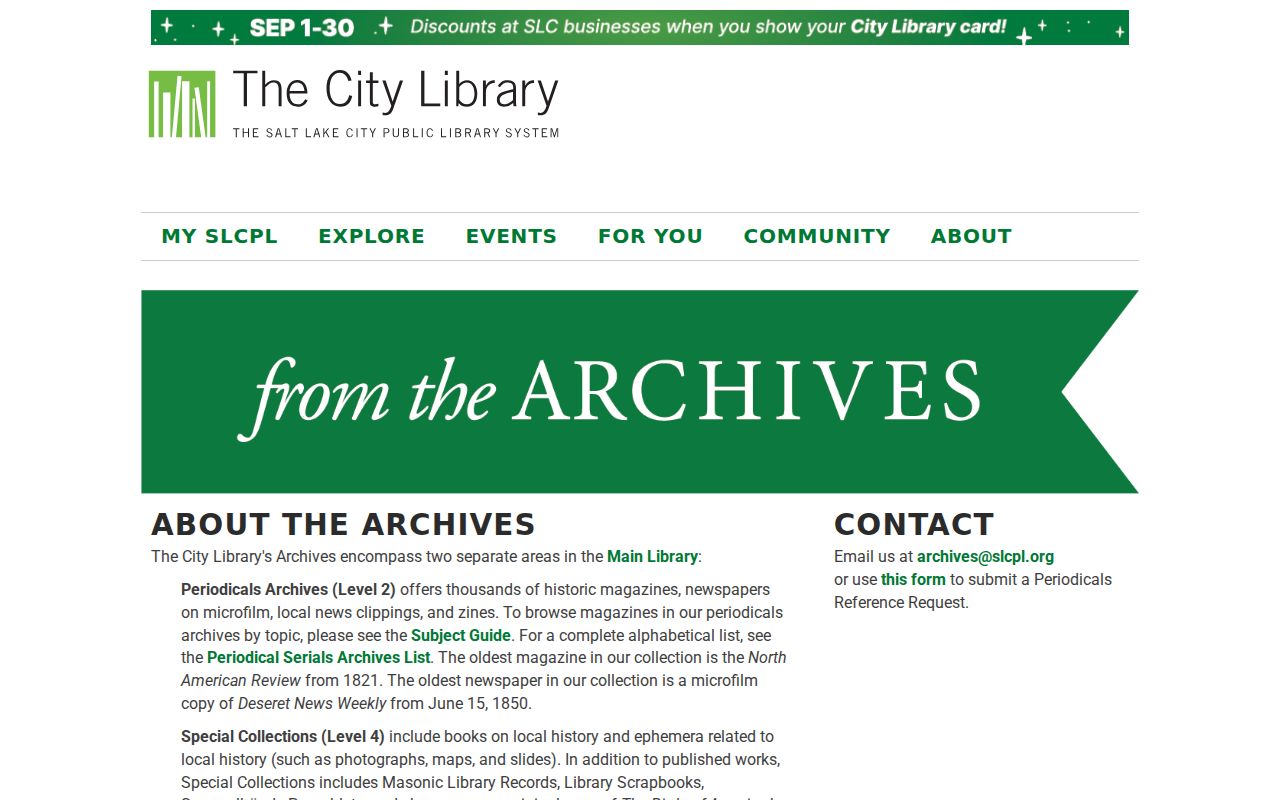
The City Library Archives page shows why the shelf includes more than city directories. Newspapers, clippings, maps, and local-history books can explain a name or address that a single volume leaves unclear.
Pair South Salt Lake City Directory Years With Census
Directories fill the years between federal censuses, while a census schedule can show more members of a household at one enumeration point. The 72-year rule shapes public census access, so use the open years available through federal and library databases. Write down the directory year, page, address, names, and marks. Then compare the nearest census year, preserving spelling differences rather than forcing a match.
- Find the earliest likely name or address in an available directory.
- Copy the entry and the abbreviation key, then record the exact street wording.
- Check the closest available census for household members and an enumeration district.
- Return to the next directory year and note moves, new names, or a disappearance.
- Use an obituary, cemetery record, probate file, or deed to test the reason for a change.
A person who disappears may have moved, died, become unlisted, or fallen outside the volume’s coverage. An obituary or probate file can name relatives, an executor, heirs, or property disposition, but it should be confirmed with the source custodian.
Newspapers, Yearbooks, and Archive Series Add Context
When a directory entry is brief, the local research shelf can add a second clue. City Library microfilm and newspaper clippings can connect a surname with Central Park, Southgate, a school, church, civic event, or street. Utah Digital Newspapers and the Utah Historical Society collections route can add newspaper or artifact context. Yearbooks and alumni collections may help reconnect former classmates, though access is controlled by the relevant school or library. FamilySearch’s Utah State Archives collection includes Salt Lake County court, naturalization, probate, burial, and vital images across uneven series years.
County Archives publishes local indexes for births from 1890–1911, deaths from 1847–1949, marriage licenses from 1887–1904, and tax appraisal cards from the 1970s–1991. It also holds deeds, plats, maps, land certificates, fire-department records, proof-of-residence records, and county minutes. These are leads to related people and places, not one combined city directory.
When the South Salt Lake City Directory Trail Stops
Do not fill an absent year with a guess. The research did not establish the last printed Salt Lake directory, exact local criss-cross years, or a complete obituary index at Granite Branch. Instead, move through the fallback chain: search the City Library catalog and microfilm, test Marriott or FamilySearch, call County Archives for an appointment, and ask Utah State Archives about the record series. For a current address, use the county Assessor, GIS, and Recorder rather than expecting a historic volume to update itself.
Digitization is active. Salt Lake County’s Recorder-led historic property-record project is listed as in progress with $85,000 funding and an aim to convert more than a century of paper records into searchable digital form. County budget documents also describe a NextScan FlexView microfilm scanner and an Outreach/Digitization Archivist. Future access may improve, but the item’s own date, repository, and page image remain the evidence today.