
What a South Salt Lake Resident Lookup Can Cover
One-person research in South Salt Lake crosses city, county, and state lines. The right starting record depends on the question. A property lead belongs with the Salt Lake County Assessor and Recorder. Registration status belongs with Vote.Utah.gov. A city citation or small-claims matter belongs with South Salt Lake Justice Court, while district cases, probate, divorce, and felony records are routed through Utah Courts Xchange. Birth and death certificates have state and county paths, and a marriage license remains with the issuing County Clerk.
| Record | What it can confirm | Where | Access |
|---|---|---|---|
| Property roll | Owner, parcel, mailing data | Salt Lake County Assessor | Free online search |
| Voter status | Registration status and address lead | Vote.Utah.gov | Free form with six fields |
| Court record | Party, case, hearing, judgment | Justice Court or Xchange | Guest/account, terminals, copies |
| Vital record | Birth, death, marriage, divorce | Utah DHHS or custodian county | Eligibility and release rules |
| License or filing | Business, principal, agent, credential | Commerce or DOPL | Free public search, some paid requests |
A result is most useful when its scope is named. An Assessor owner is not necessarily a resident. A voter match is not a household roster. A business filing is not proof that a person works at the listed address today. Keep each source in its own lane.
South Salt Lake Resident Lookup Verification Trail
Use a name and an address together whenever possible. If you have only a name, add a likely city, age range, former street, school, relative, or record date from your own notes. Do not submit more personal data than the official form needs. The goal is to find a record that can be checked, not to collect every field about a person.
- Write the full name, alternate spelling, address, and time period in a research note.
- Use the Salt Lake County Assessor to test a property or parcel connection.
- Run Vote.Utah.gov with the required name, birth date, and address fields.
- Search Xchange or the South Salt Lake Justice Court route for a matching case context.
- Confirm the result with a vital, business, license, obituary, archive, or certified record when the question calls for it.
When the issue shifts from one person to everyone on a street, use the South Salt Lake street directory workflow. A name search and an address search answer different questions, and the record custodians do not merge them into one public profile.
South Salt Lake Resident Lookup: Vote.Utah.gov Fields
The Utah voter lookup visibly asks for first name, last name, date of birth, street address, city, and ZIP. That combination can reduce a same-name error, but it remains a status check. It can support a current address lead without showing every person in a residence. A no-match can result from a spelling difference, a status change, a protected record, or an address that the form does not treat as a match.
Utah’s fuller voter file can include name, voter ID, age range, residential and mailing address, county, precinct and districts, party, active or inactive status, updated date, and vote history. Full date of birth, driver or state ID number, Social Security number, phone, and email are protected. The county Elections office supplies a file-request route. In 2026, SB 153 changed privacy classifications and created an At-Risk path. The state’s April 2 notice described letters to more than 300,000 voters and said protected identifiers remained protected.
Open the Vote Utah lookup before using this form image.
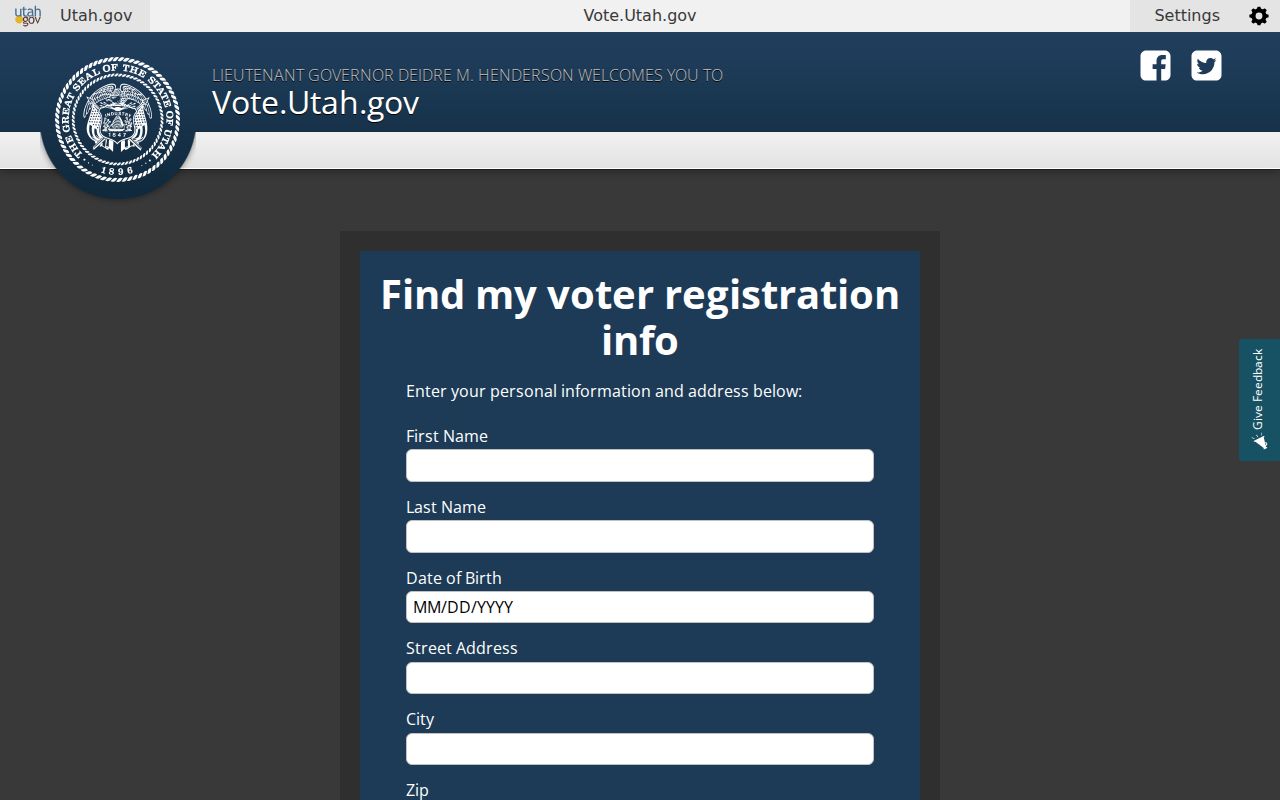
The official voter form is the right place to see current field requirements. Save the date of your check because election data and privacy rules can change.
South Salt Lake Resident Lookup Through Xchange
Utah Courts Xchange is the statewide case-information route for Utah district and justice courts. A result may show party names and addresses when available, attorneys, judges, documents, hearings, judgments, and outcomes. CORIS coverage is complete from each court’s adoption date, and Utah Courts describes electronic public documents from July 1, 2010. Some images require an account or purchase, while public courthouse terminals provide another access channel. Older files may be in Utah State Archives.
South Salt Lake Justice Court handles Class B and C misdemeanors, infractions, traffic citations, small claims, and expungements. It is at 220 E Morris Avenue, open Monday through Friday from 8 a.m. to 4 p.m., phone 801-483-6072. Court documents can be emailed with a case number or date of birth. Certified case information is listed at $4 for certification plus $0.50 per printed page. Divorce is not a city Justice Court matter; it belongs in Third District Court.
Review the Utah court-record access guide before reading this screen.
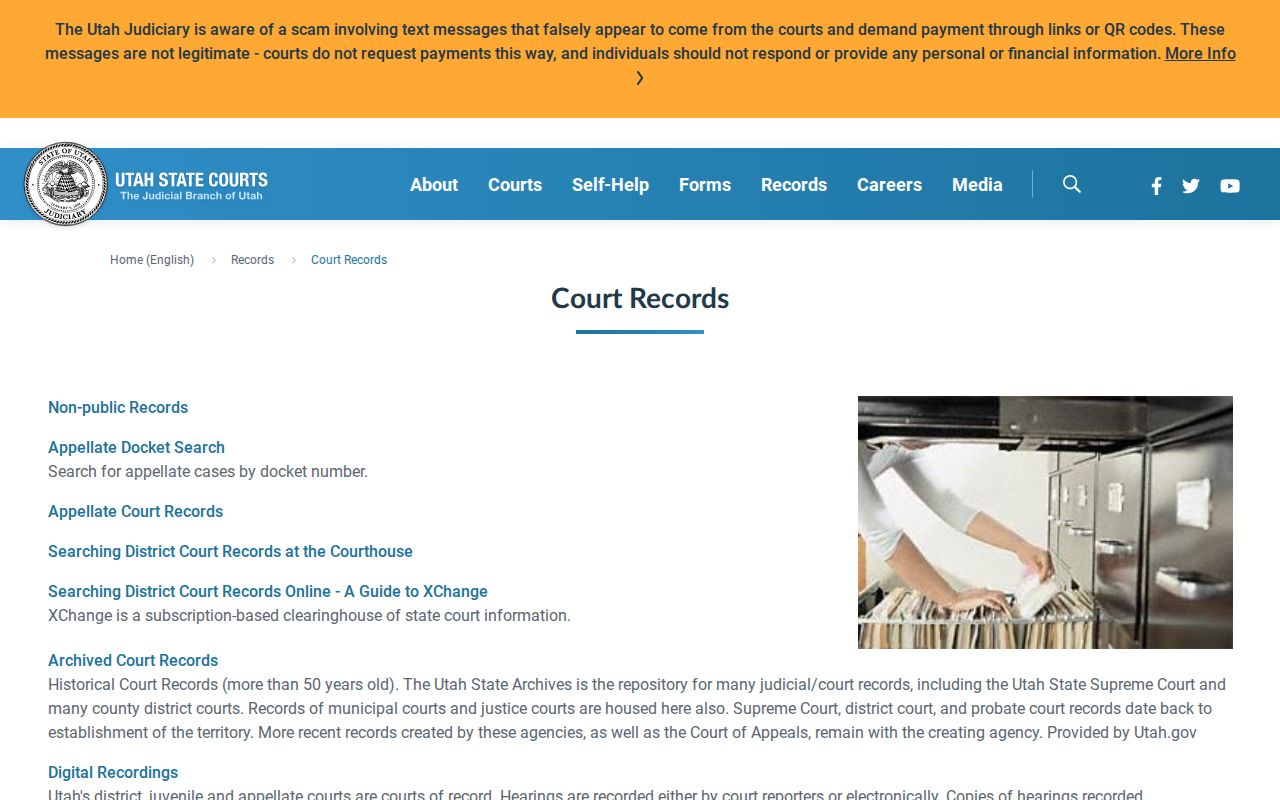
The Utah court-record access guide explains the difference between summaries, images, public terminals, archived cases, and copy requests.
South Salt Lake Resident Lookup: Vital Certificates
Utah DHHS Office of Vital Records and Statistics holds statewide birth and death records and marriage or divorce abstracts. Salt Lake County Health Department Vital Records at 610 S 200 E, Salt Lake City, handles local counter and mail service. Full county marriage licenses are held by Salt Lake County Clerk Marriage Division at 2001 S State St, Suite S2-200, phone 385-468-7300. Both parties must appear with valid ID to get a new license, and the listed $50 non-refundable fee includes two certified copies.
Utah Code §26B-8-125 sets the public release points at 100 years for birth, 50 years for death, and 75 years for other vital records such as marriage and divorce. Newer certified copies generally require a direct, tangible, legitimate interest, such as the subject, immediate family member, guardian, or legal representative. The official Utah Vital Records ordering gateway warns about third-party vendors. If a certificate is restricted, use an archive index, obituary, or family record for a lead, then ask the custodian what proof is required.
South Salt Lake Resident Lookup Same-Name Checks
A name can match more than one person in a dense Salt Lake Valley records system. Use the exact street spelling, direction, age range, case court, parcel number, business name, or family relationship that you can support. Compare an Assessor parcel with a voter address, but do not assume that an owner lives at the situs. Compare a court party with its case type and date, not just the name in a result list.
Place labels can change too. Older sources may say Salt Lake City, Millcreek, Central Park, or Southgate. South Salt Lake incorporated in 1938 and became a city in 1950, with later annexations changing the line. A historical directory or obituary may use the older label while a current permit uses South Salt Lake. Record the source’s own wording and use a legal description or plat when an address needs to be reconciled.
Lookup terms. A docket is the running case record. An index is a finding aid, while an image is the scanned or original page. A certified copy is a custodian-attested copy made for an official purpose.
South Salt Lake Resident Lookup for Family and Business
Probate can name heirs, executors, guardians, witnesses, addresses, and property descriptions. Search district probate information in Xchange, then use Utah State Archives or FamilySearch for historic Salt Lake County probate images, including a listed 1906–1913 series. Obituaries and cemetery material can add relatives and dates. For a former classmate, ask a school or library about yearbooks and alumni collections rather than treating a private roster as public.
Utah’s official adoption and birth-parent routes must be followed for birth-family work. Do not bypass a confidentiality program. For a business owner or principal, search Utah Commerce Business Entity Search and Registered Principal Search, then compare the result with South Salt Lake’s monthly business-license pages. DOPL’s public discipline screen accepts an entity name or license number. These records can confirm a filing or credential, not a person’s current home.
South Salt Lake’s County, Library, and Archives Fallback
When a web search fails, the access route continues. Salt Lake County counters handle Assessor, Recorder, and marriage questions. The South Salt Lake Justice Court can handle local case copies and audio requests. County Archives takes appointments and generally allows free inspection of its historical material. The Salt Lake City Public Library Archives offers microfilm, local clippings, maps, photographs, and reference help. Granite Branch at 3331 S 500 E provides catalog and computer access. Utah State Archives and FamilySearch supply older court, probate, naturalization, burial, and vital images.
For a record not exposed online, Utah GRAMA is the public-record request route. Utah Code §§63G-2-201 through 63G-2-205 cover inspection, classification, fees, timing, and denials. A request should identify the record, date, address, case, or parcel, and ask for inspection or copies. The custodian may redact protected information or explain that the requested compilation does not exist.
Commerce and DOPL Add a Filing or License Check
Utah Commerce searches can return an entity name or number, status, filing date, type, subtype, other name, principals, agents, and filings. Registered Principal Search can find businesses associated with a person. UCC/CFS searches use a debtor name or filing number and are separate from real-estate liens held by the county Recorder. The Commerce route can cross-check the business name and location shown on a South Salt Lake license.
DOPL covers regulated credentials in areas such as medical, nursing, pharmacy, contracting, real estate, cosmetology, legal, and education. Its public disciplinary screen shows Entity Name OR License Number. A formal verification request is a different process and the inspected form lists a $20 fee, authorization, identity fields, and receiving-agency information. Do not treat that form as a public bulk lookup.
Privacy Limits on a South Salt Lake Resident Lookup
Public records do not promise a full profile. Sealed, expunged, juvenile, private, controlled, and protected court material may not appear. DMV address data is closed under the federal DPPA. Utilities, delivery records, phone details, and every household member are not public resident lists. Utah Safe at Home gives qualifying survivors a substitute address and mail forwarding, and Utah Code §77-38-6 requires agencies to accept the substitute address. At-Risk voter records add another protection.
Correct a wrong record with the custodian that created it. Do not try to fill a gap by combining clues about a protected person. Utah Code §76-5-106.5 covers stalking conduct such as monitoring, following, observing, photographing, surveilling, repeated communication, or approaching a person.
Lawful use. A South Salt Lake resident lookup is for personal, lawful research, family history, reconnection, estate work, and civic understanding. Never use a result to stalk, harass, threaten, intimidate, or expose another person’s protected location.