
Sources for Previous Residents at a South Salt Lake Address
One address can have an owner trail and a household trail. The deed chain follows recorded transfers. A geographic city directory may show who occupied the place at a given year. Census schedules can show a fuller household when the year is public. A permit can date a change or name an applicant, while an obituary or probate file can close a family or property trail. The table keeps those uses separate.
| Source | Years or scope | Where held | What it can show |
|---|---|---|---|
| Recorder deeds and plats | Current and historic, cutoff not stated | Salt Lake County Recorder and Archives | Owners, transfers, legal descriptions |
| R.L. Polk and Utah directories | 1874; 1883–84; 1890s, 1900s, 1912–13 runs | Marriott and library collections | Names, streets, household clues |
| Federal census | Public under the 72-year rule | Federal and library databases | Household members and enumeration area |
| South Salt Lake permits | 2025–2026 archive links and current portal | City Building Permits and Cityworks | Applicants, owners, work at an address |
| Archives indexes | Births 1890–1911; deaths 1847–1949; marriage 1887–1904; tax cards 1970s–1991 | Salt Lake County Archives | Names, family, tax, and civic clues |
Start with the era you need. For a recent transfer, use the Assessor and Recorder. For a household in the early twentieth century, test the Polk pages and census. For a still older lead, ask County Archives or Utah State Archives which series and place label apply.
South Salt Lake Previous Residents: Start With One Parcel
Search the Salt Lake County Assessor by address, owner, or parcel number. Copy the current owner, parcel ID, situs address, mailing address, and legal description. The mailing address can be different from the land, and an owner is not the same as an occupant. The legal description is the key that lets an older deed remain connected even when a street name, number, or municipal label changes.
Open the county GIS parcel view to check the lot shape and adjacent parcels. If a corner or multi-unit property has more than one frontage, keep every address form in the notes. A house-history search should not silently merge a neighboring lot just because its postal label looks alike.
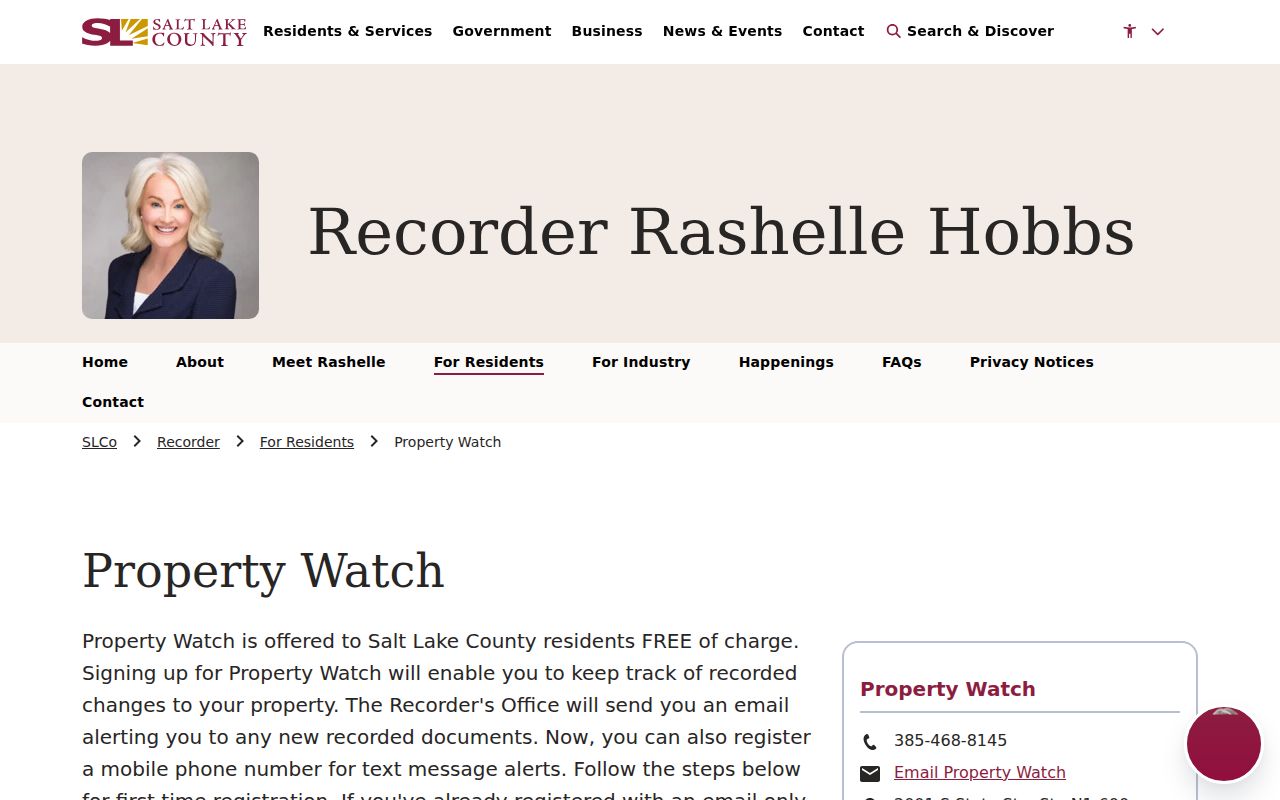
The Recorder Property Watch page shows the forward-looking alert layer. It can help track new parcel-linked documents, but an alert is not a title search and does not prove who occupied a place.
South Salt Lake Previous Residents and the County Deed Chain
The Recorder is the controlling local custodian for recorded real-property documents. Its free Public Search requires agreement to terms and an address or parcel selection. The page warns that information may be at least 24 hours old and that a title search may be needed. Data Services is the richer route for owner of record, parcel-number history, legal descriptions, recorded documents, tract index, chain of title, subdivision maps, and plats.
- Pull the latest owner and legal description from the Assessor.
- Find the latest recorded instrument and note entry number, date, grantor, and grantee.
- Use the seller or earlier grantor as the next name in the Recorder search.
- Repeat backward while matching the legal description, not only the street address.
- When the web index ends, ask the Recorder, County Archives, or a records custodian for the older series.
- Grantor
- The party conveying an interest in the recorded instrument.
- Grantee
- The party receiving the interest.
- Chain of title
- The linked sequence of recorded transfers for the same land.
- Legal description
- The formal land description that can outlast a street label.
The Recorder is at 2001 S State St, Suite N1-600, Salt Lake City, UT 84190, phone 385-468-8145. The inspected fee schedule lists $40 per recorded document, $2 per page for a recorded copy, and $5 plus $2 per page for a certified copy. Data Services advertises $5 for 24-hour access, up to 150 data units, with larger packages available.
South Salt Lake Previous Residents in Polk Pages
Ownership only tells half of the address story. The 1900 R.L. Polk Salt Lake City directory at the Marriott Digital Library is a 960-page digitized volume arranged alphabetically, geographically, and in other ways. Its metadata covers residents, streets, businesses, organizations, and institutions. Earlier material includes 1874 and the 1883–84 Utah Directory, followed by Polk runs in the 1890s, 1900s, and 1912–13.
Read a surname entry, copy the street and house number, then test the geographic pages. If a criss-cross section exists in the volume, read the street in both directions. The research does not confirm every local reverse-directory year, so ask the library or archive for the exact run rather than treating an absent scan as an absent household. The collections themselves are described on the South Salt Lake city directory page.
Read the Recorder digitization project page before viewing this project image.
The historic property digitization project is listed as in progress. It may improve access to older deeds, but it does not mean every historic page is searchable today.
South Salt Lake Previous Residents and Census Years
A directory can give a street and one or two names, while a census can show more of a household at the time of enumeration. Use public census years under the 72-year rule and note the enumeration district or local geography. Then compare the closest directory year, keeping differences in spelling, age, and place label.
- Choose a directory year near the census year you can access.
- Copy the street, house number, surname, given names, and household marks.
- Search the census by name and local area, not only by the modern city label.
- Compare household members, age, address clues, and nearby names.
- Return to the next directory year and record a move, new relation, or disappearance.
A person who vanishes from a volume may have moved, died, become unlisted, or fallen outside its coverage. An obituary or probate file can offer the next clue, but a conclusion should cite the actual page or custodian.
South Salt Lake Previous Residents in County Archives
Salt Lake County Archives preserves records from 1852 to the present and works by appointment. Its online menu includes deeds, plats, tax assessment rolls, land certificates from 1851–1895, fire-department records from 1929–2003, proof-of-residence records, maps, ordinances, water records, county minutes, civil and criminal files, and tax appraisal cards from the 1970s–1991. Published indexes include births, deaths, and marriage licenses with their own date ranges.
Call 385-468-0820 before assuming a series is open or fully online. Utah State Archives and FamilySearch add state-held court, naturalization, burial, probate, and vital images. The Salt Lake series has uneven coverage, including court and docket material, naturalization, probate listed for 1906–1913, and burial series reaching from 1848 into the twentieth century.
South Salt Lake Previous Residents and Permit Dates
Building permits can anchor a change in a house or commercial parcel. South Salt Lake lists additions, electrical installations, fences, HVAC, new buildings, paving, plumbing, renovations, signs, structural work, and commercial alterations. Applications may contain owner affidavits, current property owner, contractor, architect, subcontractor, plans, and business information. Complete applications are reviewed within 15 business days. Those fields can identify a person connected to a project and date work, but they do not prove occupancy.
Cityworks instructions say completed applications can be searched by permit or license number or address after account login. The guide documents email confirmation, document access, online payment, and email MFA beginning in April 2026. The city also publishes monthly issued-permit archive links for 2025 and 2026. Exact older coverage and export limits were not located, so keep the portal date with any result.
Central Park and Southgate Can Hide an Old Address
South Salt Lake’s civic line is younger than many valley records. The area grew through Millcreek, Central Park, and Southgate. Central Park was developed by Jesse Fox Jr. in 1890. The city incorporated on September 29, 1938 after a failed annexation effort and a push for its own sewer system, became a city in 1950, and added land through 1990s annexations. A directory, newspaper, or deed may use an older community label.
Preserve old street spellings and directionals. Vidas Avenue and Beryl Avenue honor Jesse Fox’s daughters, while the city history says Leslie Avenue’s origin is disputed. When a name or address appears to shift, compare the plat and legal description with the old page instead of assuming a move.
Obituaries and Probate Close the Past-Resident Trail
An obituary can name relatives, former places, dates, and a funeral or cemetery route. Probate can add heirs, executors, guardians, witnesses, property descriptions, and disposition. Search Xchange for district-court probate information, then use County Archives or FamilySearch for older Salt Lake County images. The Utah vital release rules matter: births become public after 100 years, deaths after 50, and marriage or divorce after 75 under Utah Code §26B-8-125.
Use these records as endpoints, not as a reason to infer a living person’s current location. The County Archives and City Library can help with local indexes, newspapers, microfilm, and older maps. A death or probate reference should be checked against the custodian and exact date.
Past Residents Research Has Clear Limits
A deed chain cannot list every household member. A directory may omit renters, children, boarders, or people who were not included in the volume. DMV and utility data are not open address lists, and sealed, expunged, juvenile, private, and protected records may be absent. Safe at Home gives qualifying survivors a substitute address and mail forwarding, and Utah Code §77-38-6 requires agencies to accept it.
Lawful use. Research South Salt Lake previous residents for house history, genealogy, estate work, and personal curiosity. Do not use a past-resident record to track, stalk, harass, intimidate, threaten, or expose a living person.